
Ford Transit Ignition Barrel Specialist Staffordshire
Stiff, seized, or completely dead Transit ignition — one of the most common commercial vehicle faults in the UK. Ben diagnoses whether it's mechanical wafer wear or a PATS antenna ring fault, and repairs or replaces the barrel on-site across Staffordshire.
Why "Transit Ignition Fault" Is Actually Two Different Problems
The Ford Transit ignition barrel is one of the most heavily used mechanical components on any commercial vehicle in the UK — a working van can see the key inserted and removed a dozen times a day, every working day, for years. That level of use produces two genuinely distinct failure modes that both present as "the ignition doesn't work," but need completely different fixes.
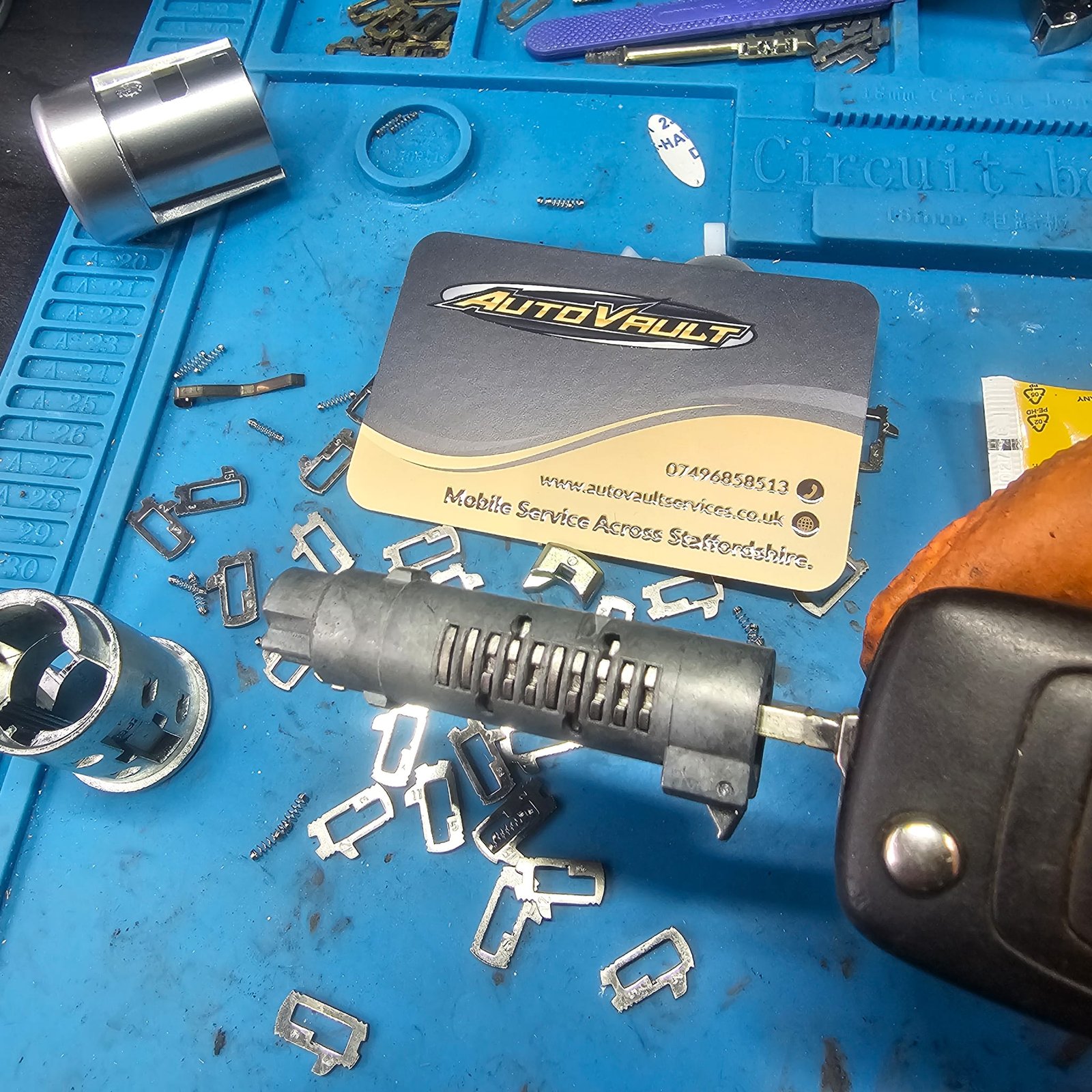
The first is mechanical wafer wear — the spring-loaded tumblers inside the barrel physically wearing down until the key can no longer push them into the correct position to release the lock. The second is a PATS antenna ring fault — the immobiliser antenna coil wrapped around the barrel that reads the key's transponder chip failing or losing connection, which stops the engine starting even if the barrel itself turns perfectly.
Diagnosing which one is actually happening determines whether the fix is a barrel rebuild, a barrel replacement, or an antenna ring repair — three different jobs with three different costs. See Ford Transit & Custom Locksmith for the full range of Transit key and lock services, and Ignition Repair and Replacement for general ignition fault coverage across all makes.
Which Fault Do You Actually Have?
These symptoms help narrow down whether this is wafer wear, an antenna ring fault, or something else entirely — useful information to have ready when you call.
Two Failure Points Inside the Same Ignition Assembly
How Each Failure Mode Develops
Mechanical Wafer Wear
Every key insertion and turn puts physical stress on the wafers. High daily cycle counts — typical of commercial use — accelerate this wear far faster than on a privately owned car. Eventually the wafers no longer align correctly, and the barrel becomes stiff, sticks, or refuses to turn at all.
PATS Antenna Ring Fault
The antenna ring coil can degrade from heat cycling, vibration, or a cracked solder joint on its connection to the wiring loom. When this happens, the key can turn the barrel mechanically without issue, but the PCM never receives valid transponder data, so the immobiliser refuses to allow the engine to start.
How Wear Patterns Differ Across Generations
Mk6 Transit (2000–2006)
Now at an age where mechanical wafer wear is common across most surviving high-mileage examples. Barrels on this generation are frequently at or near end of life.
Mk7 Transit (2006–2013)
The generation most frequently reported for ignition barrel failure — a combination of production-era component tolerances and now-high mileage on commercially used examples.
Mk8 Transit (2013–2023)
Barrel faults are less common at current mileages, but antenna ring faults do occur, particularly on higher-mileage examples used intensively in commercial fleets.
Transit Custom (all gens)
Shares the ignition architecture of the equivalent-year Transit — wear patterns and fault types are broadly the same as the standard Transit of the same generation.
🔍 Why Getting the Diagnosis Right Matters
Replacing a barrel when the actual fault is the antenna ring does not fix the problem — the new barrel will have exactly the same starting fault, because the antenna ring is often supplied separately or integrated differently depending on the part sourced. Equally, attempting an antenna ring repair on a barrel with worn wafers leaves the mechanical fault untouched.
Ben diagnoses which component has actually failed before recommending any work — avoiding a repair that does not resolve the real fault.
Transit ignition playing up or stiff to turn?
Call with the symptoms and van generation — Ben will help narrow down the likely fault before attending.
Ford Transit Ignition Barrel Work
From diagnosis through to repair, replacement, and antenna ring resolution — on-site across Staffordshire.
Barrel vs Antenna Ring Diagnosis
Determining exactly which component has failed before recommending any work — the starting point for every Transit ignition job, since the two faults require completely different fixes.
Wafer Rebuild / Barrel Repair
Where wear is confined to the wafer tumblers and the housing is otherwise sound, rebuilding the mechanical assembly to restore smooth operation without a full replacement.
Full Barrel Replacement
Where the barrel is beyond repair, sourcing and fitting a replacement keyed to the existing key wherever possible, so no new key is needed.
PATS Antenna Ring Repair
Diagnosing and resolving antenna ring faults — connection issues, degraded coils, or wiring faults — that prevent the immobiliser recognising a correctly-turning key.
Broken Key in Transit Ignition
Extraction of a snapped key fragment from the barrel, combined with barrel assessment and repair or replacement if needed. See Broken Key Extraction.
Full Transit Key & Lock Service
Where the ignition fault sits alongside a key or spare key need, both are handled in the same visit. See Ford Transit & Custom Locksmith for the complete range.
Wafer Wear vs Antenna Ring Fault — Side by Side
Use this as a rough guide before calling — Ben will confirm the actual cause on-site, but knowing which pattern matches your symptoms helps set expectations.
| Symptom | Wafer Wear | Antenna Ring Fault |
|---|---|---|
| Key feels stiff to turn | Yes — classic sign | No — turns normally |
| Engine cranks but will not fire | Rare | Yes — classic sign |
| Immobiliser light stays on | Not typically | Yes, often |
| Fault is intermittent with key position | Rare | Common |
| Fix required | Barrel rebuild or replace | Antenna ring repair |
See Automotive Module Services for the wider electronic diagnostic work that antenna ring and PATS faults sit alongside.
Ford Transit 2018 — Ignition Barrel Seizure, Stone Staffordshire
A mechanical wafer failure resolved on-site without a tow.
Ford Transit 2018
A driver had their Transit ignition barrel seize completely mid-working day — the key would not turn at all, consistent with mechanical wafer wear rather than an antenna ring or immobiliser fault. Ben confirmed this on-site, built a new ignition barrel keyed to the customer's existing key, and had the van running again in 40 minutes. No tow, no dealer, and the customer kept the same key throughout.
This is a textbook mechanical wafer failure case — see the full write-up on the Ignition Repair and Replacement page and the Ford Transit service page.
Correct Diagnosis First
Wafer wear and antenna ring faults are diagnosed separately before any repair begins — avoiding work that does not fix the actual problem.
30-Minute Average Response
Based in Uttoxeter, covering all of Staffordshire. On-site attendance means no recovery truck and no lost working day waiting for a dealer slot.
DBS Checked & Insured
Current DBS check and £5M public liability insurance. Standards via the Master Locksmiths Association and SERMI.
What Staffordshire Customers Say
EXCELLENT Based on 65 reviews
 Posted on Google
 Matt KAutoVault came to produce a spare key for my vehicle and programme a lost one out of the system. The service was exceptional and communication was excellent throughout. I was called before arrival (on time) and he did a stellar job. My vehicle posed several issues with the programming process and he went above and beyond to resolve this for me, perservering and having to come back the next day after some additional time and work was needed to complete the job which he did successfully. Extremely knowledgeable and professional, and a top guy! I cannot recommend this company highly enough. I will definitely use again in future.Posted on Google
 Nigel BirchBen was very knowledgeable and knew exactly what to do with my BMW X1 key. He even repaired my old key. A very efficient service provided.Posted on Google
 MattFaultless service!Posted on Google
 Rachel BrianFast and professional service. I rang Ben to replace my lost car key, he rang back within the hour with a price. The following morning he arrived bang on time and supplied a genuine Range Rover key. Excellent communication and a hassle free service at a great price.Posted on Google
 Terry Downescalled on the morning and got us out of a sticky situation,fantastic service just as a business should be run,great communication done exactly what was agreed for a cracking price after other locksmiths said it was impossible to do and that only the main dealer can do,which was wrong thanks again autovault 👌Posted on Google
 amy stewartWe were locked out our car at Alton Towers and had no other option but to Google for car locksmith. We tried the first one that came up and so glad we did! They came to us within 20 minutes, got us in the car quickly with no damage at all done to the car. Would 100% recommend if you are in the area. We are from Scotland so wasn't sure who to use but glad we used these guys.Posted on Google
 Helena BeareI have a courtesy car and the key fob stopped working. The garage were shut for the whole weekend and I needed the use of a car. Ben was amazing and went over and beyond. He was very patient with me trying to identify where the emergency override was. . He then offered to come out and he arrived within 15 minutes. Bizarrely the key fob started to work as he pulled up. He still checked the fobs battery for me and showed me where the override on the car was. He refused to charge me the agreed call out charge. In fact he refused to charge me at all. If I could have given him 10 stars I would .Very knowledgeable and a gentleman. If you ever get locked out of your car definitely give Ben a callPosted on Google
 Nasser MansourBen was unbelievable!! A Wizard in my eyes, was able to open the vehicle with every possible manufacturer or mechanical expert that were unable to!! Ben is the Man 👌🏼🙏🏼Posted on Google
 Christian LancelottOutstanding, quality service at a reasonable price. Ben went above and beyond to ensure I was back on the road which I really appreciate. I think he had to utilise all his knowledge and expertise whilst having to improvise on my challenging mercedes immobilser failure. He has a real talent and professionalism. Thank youPosted on Google
 Malc BaileyFantastic Service Very Helpful ThanksVerified by TrustindexTrustindex verified badge is the Universal Symbol of Trust. Only the greatest companies can get the verified badge who has a review score above 4.5, based on customer reviews over the past 12 months. Read more
Ford Transit Ignition Barrel — Frequently Asked Questions
Transit Ignition Playing Up?
Call or WhatsApp Ben with the symptoms — likely fault narrowed down before attending, no call-out fee, anywhere in Staffordshire.